Principles of Routing:What are the fundamental principles of routing in computer networks?
Q: What are the fundamental principles of routing in computer networks?
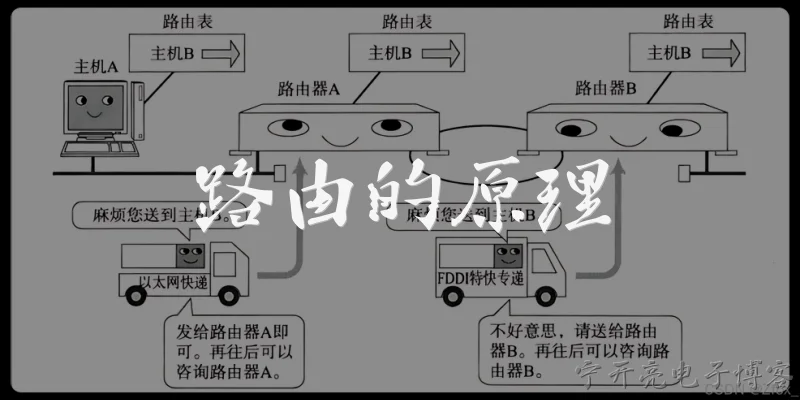
A: The fundamental principles of routing involve determining the optimal path for data packets from a source to a destination across interconnected networks. Key principles include path determination, where routers use algorithms and metrics like hop count, bandwidth, or delay to select the best route; forwarding, which is the actual movement of packets based on routing tables; and adaptability, allowing routes to change dynamically in response to network failures or congestion. Routing also relies on the concept of least-cost routing, where the path with the lowest metric is preferred. Additionally, routing must handle scalability through hierarchical addressing and aggregation, and ensure loop-free forwarding using techniques like split horizon or TTL. Overall, these principles ensure efficient, reliable, and scalable data delivery in networks such as the Internet.
Q: How do routing algorithms implement the principles of routing?
A: Routing algorithms implement routing principles by computing optimal paths and populating routing tables. Distance-vector algorithms, like RIP, use the Bellman-Ford principle, where each router shares its entire routing table with neighbors, and distances are updated iteratively based on neighbor information. Link-state algorithms, like OSPF, apply Dijkstra's shortest-path principle, where each router floods link-state advertisements to build a complete topology map, then calculates shortest paths independently. Both approaches embody the principle of least-cost routing by using metrics to evaluate paths. They also incorporate the principle of dynamic adaptation: distance-vector reacts to changes via periodic updates, while link-state triggers updates on topology changes. Additionally, algorithms enforce loop prevention—distance-vector uses split horizon and poison reverse, link-state uses sequence numbers. Thus, algorithms translate abstract routing principles into concrete, distributed decision-making processes.
Q: What is the principle of hierarchical routing and why is it important?
A: Hierarchical routing is a principle that organizes networks into multiple levels or domains to improve scalability and reduce routing table size. In this approach, routers within a domain (e.g., an autonomous system) only need detailed knowledge of internal topology, while a backbone or area border routers summarize routes to other domains. For example, OSPF uses areas, and BGP uses autonomous systems. The importance lies in scalability: without hierarchy, every router would need a route to every network, causing enormous tables and excessive update traffic. Hierarchy also localizes changes—a link failure within one area does not affect other areas' routing tables. Furthermore, it enforces policy and administrative boundaries, as seen in inter-domain routing. By aggregating addresses and restricting routing information exchange, hierarchical routing embodies the principle of divide-and-conquer, enabling the global Internet to function efficiently despite its massive size and complexity.
Q: How do routing principles ensure loop-free forwarding and reliability?
A: Routing principles ensure loop-free forwarding and reliability through several mechanisms. First, loop prevention is achieved via techniques like split horizon (never advertise a route back to the interface it was learned from), poison reverse (advertise such routes with infinite metric), and hold-down timers to avoid flapping. Link-state protocols use sequence numbers and aging to prevent stale information. Second, reliability is enhanced by redundancy and failover: routing protocols dynamically reconverge after topology changes, selecting alternate paths. Third, the principle of least-cost routing combined with metrics like hop count or bandwidth avoids inefficient loops. Fourth, Time-to-Live (TTL) in IP headers ensures packets are discarded if they loop too long. Finally, reliability is supported by error detection and acknowledgment mechanisms in routing updates, as well as authentication to prevent malicious route injection. Together, these principles maintain stable, loop-free, and resilient packet forwarding across diverse network conditions.
Words of experience
Common scenarios of "Principles of Routing"
【Professor】 Good morning, class. Today we'll discuss the principles of routing in computer networks. Can anyone define routing?
【Student】 Routing is the process of selecting paths in a network along which to send network traffic.
【Professor】 Exactly. Routing involves forwarding data packets based on their destination addresses. What are the key components of a routing system?
【Student】 Routing protocols, routing tables, and forwarding mechanisms.
【Professor】 Correct. Routing protocols determine how routers communicate and share information about network topology. Can you name some common routing protocols?
【Student】 RIP, OSPF, BGP, and EIGRP.
【Professor】 Good. These protocols can be classified as interior gateway protocols (IGPs) and exterior gateway protocols (EGPs). What's the difference?
【Student】 IGPs are used within an autonomous system, like OSPF and RIP. EGPs are used between autonomous systems, like BGP.
【Professor】 Right. Now, let's discuss routing algorithms. What are the main types?
【Student】 Distance-vector and link-state algorithms.
【Professor】 Yes. Distance-vector algorithms use Bellman-Ford, while link-state use Dijkstra's algorithm. What are the advantages of link-state over distance-vector?
【Student】 Link-state converges faster and avoids routing loops, but it requires more memory and processing power.
【Professor】 Good point. Now, what is hierarchical routing and why is it used?
【Student】 Hierarchical routing divides the network into regions to reduce routing table size and control overhead.
【Professor】 Exactly. The Internet uses hierarchical routing with autonomous systems. What is the role of BGP in this context?
【Student】 BGP exchanges routing information between autonomous systems and applies policies to determine the best paths.
【Professor】 Yes, BGP is a path-vector protocol. Now, what are some challenges in routing?
【Student】 Scalability, convergence time, security, and quality of service.
【Professor】 Absolutely. Security is a major concern, with attacks like BGP hijacking. How can we mitigate such attacks?
【Student】 Using RPKI, route filtering, and monitoring tools.
【Professor】 Great. That covers the principles of routing. Next time, we'll dive into routing in software-defined networking. Any questions?
【Student】 No, thank you. That was very informative.