QAM principle:What is the QAM principle and how does it work?
Q: What is the QAM principle and how does it work?
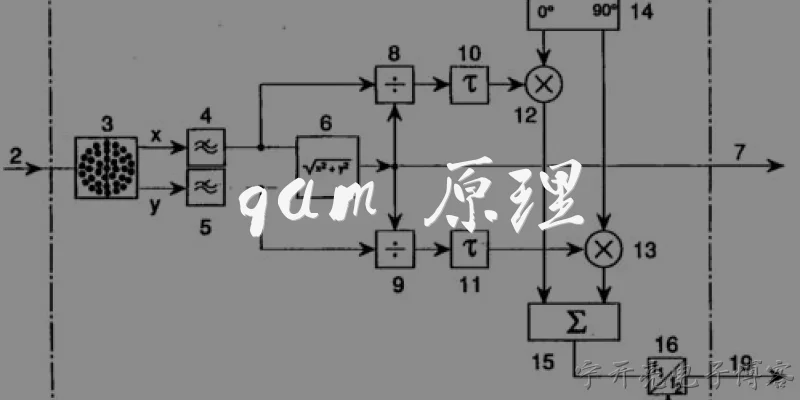
A: The QAM (Quadrature Amplitude Modulation) principle is a modulation technique that combines both amplitude and phase variations to transmit digital data over a carrier wave. It works by using two orthogonal carriers: an in-phase (I) signal and a quadrature (Q) signal, which are 90 degrees out of phase. Each carrier is amplitude-modulated independently, and the resulting signals are summed to form the transmitted waveform. At the receiver, the process is reversed: the received signal is demodulated by multiplying it with the same in-phase and quadrature carriers, then low-pass filtered to recover the original I and Q components. These components map to a specific symbol in a constellation diagram, where each point represents a unique combination of amplitude and phase. The number of points in the constellation determines the modulation order, such as 16-QAM (4 bits per symbol) or 64-QAM (6 bits per symbol). The QAM principle enables high spectral efficiency, making it widely used in Wi-Fi, cable modems, and digital video broadcasting.
Q: Why is the QAM principle important in modern communication systems?
A: The QAM principle is crucial in modern communication systems because it provides a highly efficient way to transmit digital data within limited bandwidth. Unlike simpler modulation schemes like ASK or PSK, which use only amplitude or phase variations, QAM exploits both dimensions simultaneously, allowing more bits to be encoded per symbol. For example, 256-QAM transmits 8 bits per symbol, significantly increasing data throughput without requiring additional bandwidth. This efficiency is essential for high-speed applications such as 5G, Wi-Fi 6, and digital cable TV, where large volumes of data must be delivered reliably. However, higher-order QAM is more susceptible to noise and interference because constellation points are closer together, requiring better signal-to-noise ratios. Therefore, adaptive modulation is often used, where the system switches between QAM orders based on channel conditions. Overall, the QAM principle balances spectral efficiency and robustness, making it a cornerstone of contemporary wireless and wired communication standards.
Q: What are the key advantages and limitations of the QAM principle?
A: The QAM principle offers several key advantages. First, it achieves high spectral efficiency by encoding multiple bits per symbol, enabling faster data rates within a given bandwidth. Second, it is flexible: different modulation orders (e.g., 16-QAM, 64-QAM, 256-QAM) can be selected based on channel quality. Third, it is relatively simple to implement using standard digital signal processing techniques. However, QAM also has limitations. As the modulation order increases, the distance between constellation points decreases, making the signal more vulnerable to noise, fading, and nonlinear distortion. This requires higher transmit power or better error correction, which can increase cost and complexity. Additionally, QAM is sensitive to phase noise and frequency offsets, demanding precise synchronization. In practice, these limitations are managed through adaptive modulation, forward error correction, and equalization. Despite these challenges, the QAM principle remains a fundamental and widely adopted technique in digital communications, offering a practical trade-off between data rate and reliability.
Words of experience
Common scenarios of "QAM principle"
【Student】 Professor, I've been reading about digital modulation, and QAM keeps coming up. Can you explain what QAM is?
【Professor】 Sure! QAM stands for Quadrature Amplitude Modulation. It's a modulation scheme that combines both amplitude and phase modulation to transmit data.
【Student】 How does it combine amplitude and phase? I thought modulation usually uses one or the other.
【Professor】 Good question. In QAM, we use two carrier waves that are out of phase by 90 degrees—called in-phase (I) and quadrature (Q) components. Each component is amplitude-modulated independently, and then they're summed. The combination of amplitudes on I and Q creates a unique symbol that represents multiple bits.
【Student】 So the I and Q components are like two separate signals? How do they carry information?
【Professor】 Exactly. The I signal is multiplied by a cosine wave, and the Q signal by a sine wave. The amplitudes of these signals determine the symbol. For example, in 16-QAM, each symbol carries 4 bits, so there are 16 possible combinations of amplitudes on I and Q.
【Student】 16 combinations? How are they arranged?
【Professor】 They're typically arranged in a grid called a constellation diagram. For 16-QAM, it's a 4x4 grid, with each point representing a unique symbol. The horizontal axis is the I component, and the vertical axis is the Q component.
【Student】 So each point in the grid corresponds to a specific 4-bit pattern?
【Professor】 Yes. For instance, the point at (+1, +1) might represent 0000, and others are mapped accordingly. The mapping is usually Gray coded to minimize bit errors.
【Student】 Gray coding? Why is that important?
【Professor】 In Gray coding, adjacent symbols differ by only one bit. So if noise causes a symbol to be mistaken for a neighboring one, only one bit error occurs instead of multiple. This improves error performance.
【Student】 That makes sense. So higher-order QAM like 64-QAM would have more points and carry more bits per symbol?
【Professor】 Correct. 64-QAM has 64 points, each carrying 6 bits. 256-QAM carries 8 bits per symbol. The trade-off is that higher-order QAM is more susceptible to noise because the points are closer together.
【Student】 So there's a balance between data rate and robustness. How do we decide which QAM order to use?
【Professor】 It depends on the channel conditions. In good conditions with high SNR, you can use higher-order QAM for higher throughput. In noisy conditions, you might fall back to lower-order QAM like QPSK (which is a special case of QAM) for reliability.
【Student】 QPSK is a special case? How so?
【Professor】 QPSK uses four points, each with the same amplitude but different phases. It can be seen as 4-QAM where the amplitudes are equal. So QAM generalizes both amplitude and phase shifts.
【Student】 What about demodulation? How does the receiver figure out which symbol was sent?
【Professor】 The receiver multiplies the received signal with the cosine and sine carriers separately, then integrates over the symbol period. This recovers the I and Q amplitudes. Then it finds the closest constellation point, which gives the estimated symbol.
【Student】 So it's like a matched filter? And then decision boundaries?
【Professor】 Exactly. The decision boundaries are typically halfway between constellation points. The receiver decides based on which region the received point falls into.
【Student】 What are some practical applications of QAM?
【Professor】 QAM is used in many communication systems: Wi-Fi (e.g., 64-QAM, 256-QAM), digital cable TV, DSL, and cellular networks like LTE and 5G. It's a key technology for high-speed data transmission.
【Student】 Thank you, Professor. I think I have a clear understanding now.