Features of armored thermal resistors:What are the main structural features of an armored thermal resistor?
Q: What are the main structural features of an armored thermal resistor?
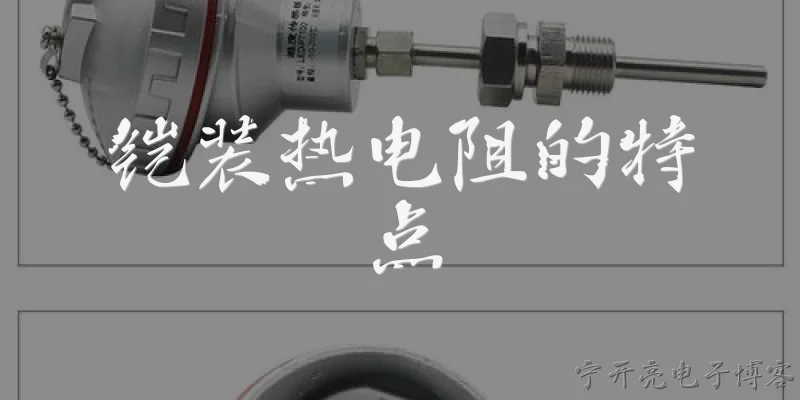
A: An armored thermal resistor features a temperature-sensing element (usually a platinum RTD) enclosed in a protective metal sheath, often made of stainless steel, with mineral insulation such as magnesium oxide packed between the element and the sheath. This construction provides excellent mechanical strength, resistance to vibration and shock, and protection against corrosive media. The compact, bendable probe design allows installation in tight spaces and complex piping. Lead wires are sealed at one end, and the small diameter enables fast thermal response. These features make armored thermal resistors suitable for harsh industrial environments where durability and reliability are essential.
Q: How does the response time of an armored thermal resistor compare to other sensors?
A: Armored thermal resistors generally offer fast response times because of their small sheath diameter and direct contact between the sensing element and the protective sheath. The thin metal wall and compact design reduce thermal lag, allowing quick detection of temperature changes. Compared with bulky assembled sensors, armored types respond more rapidly, making them suitable for dynamic processes. However, response speed also depends on sheath diameter, insulation material, and installation depth. Smaller diameters yield faster response, while larger ones provide more protection but slower reaction. Overall, armored thermal resistors balance speed and durability effectively.
Q: What environmental conditions can armored thermal resistors withstand?
A: Armored thermal resistors are designed to withstand demanding environments, including high pressure, high vibration, mechanical shock, and corrosive atmospheres. The stainless steel sheath and mineral insulation protect the sensing element from moisture, chemicals, and contaminants. They operate across wide temperature ranges, often from cryogenic levels up to several hundred degrees Celsius depending on the sheath material and element type. Their robust sealed construction also resists oxidation and abrasion, making them suitable for applications in petrochemical, power generation, and process industries where reliability and long service life under harsh conditions are critical.
Q: Why are armored thermal resistors easy to install and maintain?
A: Armored thermal resistors are easy to install because their flexible, small-diameter probes can be bent to fit complex piping and tight spaces, and they are available with standard threaded or flanged fittings for quick mounting. The sealed construction eliminates the need for separate protective wells in many cases, simplifying installation. Maintenance is also straightforward: the robust sheath resists damage, reducing replacement frequency, and the modular design allows quick disconnection and interchange without major system shutdown. These features lower installation labor costs and minimize downtime, which is especially valuable in continuous industrial processes.
Q: What are the advantages of the armored construction for temperature measurement accuracy?
A: The armored construction enhances measurement accuracy by protecting the RTD element from mechanical stress, contamination, and moisture that could cause drift or failure. The mineral insulation maintains stable electrical properties and shields the element from environmental interference. Tight packing and consistent sheath dimensions promote uniform heat transfer, reducing measurement error. Additionally, the robust design allows direct immersion in process media without additional protection tubes, minimizing thermal lag and improving response accuracy. Combined with the inherent linearity and stability of platinum RTDs, armored thermal resistors deliver reliable, repeatable temperature readings even in harsh industrial conditions.
Words of experience
Common scenarios of "Features of armored thermal resistors"
【Engineer】 Hello everyone, today we're going to discuss the features of armored thermal resistors. First, let me briefly explain what an armored thermal resistor is—it's a temperature sensor that encapsulates the resistor element inside a metal armor sleeve, filled with insulating material.
【Technician】 Yes, I've used it before. The most notable feature is its mechanical protection. The armor sleeve can withstand high pressure and impact, making it suitable for harsh industrial environments.
【Engineer】 Exactly. So what are the advantages of armored thermal resistors compared to ordinary thermal resistors?
【Technician】 The main advantages are high mechanical strength, good vibration resistance, and corrosion resistance. The armor sleeve material is usually stainless steel, which can adapt to various media.
【Engineer】 Right. Another important point is the small size and short thermal response time. Because the resistor element is very close to the armor wall, heat conduction is fast.
【Technician】 This is especially important for temperature measurement in dynamic processes. For example, in pipeline flow measurement, a fast response is required.
【Engineer】 Let's talk about the structural features. Armored thermal resistors usually consist of a resistor element, an armor sleeve, an insulating filler, and lead wires. The filler is typically high-purity magnesium oxide powder.
【Technician】 Magnesium oxide powder not only provides insulation but also fixes the resistor element and prevents vibration. This is key to ensuring stability.
【Engineer】 What about the wiring methods? Armored thermal resistors can be configured as two-wire, three-wire, or four-wire systems.
【Technician】 Three-wire is the most commonly used because it can compensate for lead resistance and improve measurement accuracy. Four-wire is more accurate but more expensive.
【Engineer】 Now let's talk about the types of temperature-sensing elements. Armored thermal resistors can use PT100, PT1000, Cu50, etc. PT100 is the most common.
【Technician】 PT100 has good linearity and stability, with a wide temperature range, typically -200°C to +600°C. Armored structures can also be customized for higher temperatures.
【Engineer】 What about installation methods? Armored thermal resistors are usually threaded, flanged, or welded.
【Technician】 Threaded connections are most common, easy to install and replace. Flange connections are suitable for high-pressure pipelines. Welding is used for fixed installations.
【Engineer】 In terms of protection, armored thermal resistors usually have a protection grade of IP65 or higher, which is waterproof and dustproof.
【Technician】 Yes, some products reach IP68 and can be used underwater for a long time. However, the sealing structure must be reliable.
【Engineer】 Another feature is bending resistance. The armor sleeve can be bent appropriately, making it easy to route in complex locations.
【Technician】 But the bending radius should not be too small, otherwise it may damage the insulation layer or the resistor element. Generally, a bending radius of at least 5 times the outer diameter is recommended.
【Engineer】 Finally, let's talk about application scenarios. Armored thermal resistors are widely used in petroleum, chemical, metallurgy, electric power, and food industries.
【Technician】 In high-temperature and high-pressure environments, such as boiler temperature measurement and reactor temperature monitoring, armored thermal resistors are an ideal choice. Their reliability and durability are very important.