Ceramic tube wirewound resistor:What is a ceramic tube wirewound resistor and how is it constructed?
Q: What is a ceramic tube wirewound resistor and how is it constructed?
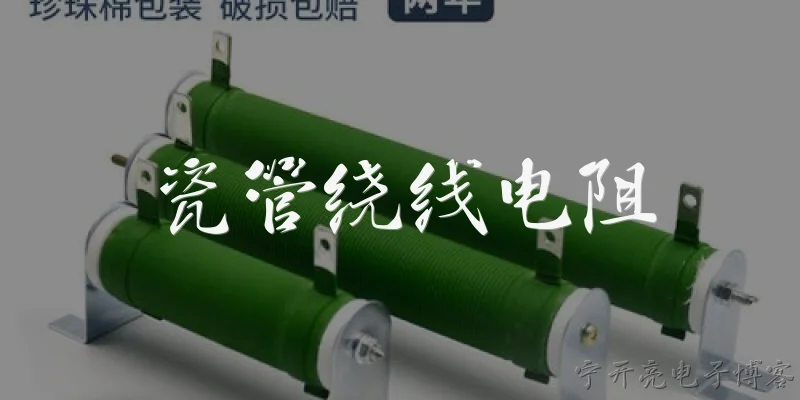
A: A ceramic tube wirewound resistor is a type of power resistor built by winding a resistive wire, typically nichrome or a similar alloy, around a cylindrical ceramic core. The ceramic tube provides excellent thermal conductivity and electrical insulation, allowing the resistor to dissipate heat efficiently even under high power loads. After winding, the assembly is often coated with a protective layer such as vitreous enamel, silicone, or cement to shield the wire from moisture, mechanical damage, and corrosion. The resistance value is determined by the wire's resistivity, its length, and its cross-sectional area, so manufacturers select specific wire gauges and turn counts to achieve target values. End caps or terminals are attached for electrical connection, and the whole unit is designed to withstand elevated temperatures. This construction makes ceramic tube wirewound resistors well suited for power supplies, motor drives, and industrial equipment where durability and heat tolerance matter.
Q: What are the main advantages and typical applications of ceramic tube wirewound resistors?
A: Ceramic tube wirewound resistors offer several key advantages: high power handling capability, excellent heat dissipation through the ceramic core, low inductance compared to some alternatives when wound in specific patterns, and strong mechanical and thermal stability. They can operate at high temperatures and resist moisture and vibration when properly coated. Because of these traits, they are commonly used in power supplies, motor control circuits, braking resistors, load banks, and industrial heating equipment. They also appear in current-limiting and voltage-dividing roles where robustness matters more than precision. However, they are not ideal for high-frequency circuits due to inherent inductance, and their resistance tolerance is generally wider than precision film resistors. Overall, they are a dependable choice for demanding power applications where reliability and thermal performance are priorities.
Q: How do you select the correct power rating and resistance value for a ceramic tube wirewound resistor?
A: Selecting the right ceramic tube wirewound resistor starts with calculating the actual power dissipation in your circuit using P = I²R or P = V²/R, then choosing a resistor rated well above that figure, often with a 50 to 100 percent safety margin to account for ambient temperature and surge conditions. Consider derating curves, since power ratings are usually specified at a reference temperature such as 25°C and decrease at higher temperatures. For resistance value, work backward from the required current or voltage drop, and verify tolerance against your circuit's needs. Also evaluate inductance if the signal contains high frequencies, and check the pulse or surge capability if the resistor will see transient loads. Finally, confirm the physical size, mounting style, and coating type suit your environment, since cooling conditions strongly affect real-world performance.
Q: What maintenance and safety considerations apply when using ceramic tube wirewound resistors?
A: Ceramic tube wirewound resistors can reach high surface temperatures during operation, so they should be mounted away from heat-sensitive components and with adequate ventilation or heatsinking. Ensure the enclosure or mounting arrangement allows free airflow to prevent overheating and premature failure. Check the coating periodically for cracks, discoloration, or flaking, which can expose the wire and compromise insulation. Use proper derating for continuous operation near maximum power, and avoid exceeding rated voltage or surge limits. When servicing equipment, disconnect power and allow the resistor to cool before handling, since stored thermal energy can cause burns. Also verify terminal connections remain tight to prevent arcing or localized heating. Following the manufacturer's datasheet for mounting orientation, clearance, and environmental limits is the most reliable way to ensure long, safe service life.
Words of experience
Common scenarios of "Ceramic tube wirewound resistor"
【Electrical Engineer】 Good morning. I'd like to discuss the ceramic tube wirewound resistor with you today. Could you start by explaining what it is and where it's typically used?
【Component Specialist】 Good morning. A ceramic tube wirewound resistor consists of a ceramic core, usually made of alumina or steatite, with a resistive wire such as nichrome wound around it. It's commonly used in power supplies, motor drives, and industrial equipment where high power handling and heat dissipation are required.
【Electrical Engineer】 Why is ceramic chosen as the core material instead of something like fiberglass or plastic?
【Component Specialist】 Ceramic offers excellent thermal conductivity and can withstand very high temperatures, often up to 250°C or more on the surface. It also provides good electrical insulation and mechanical rigidity, which keeps the winding stable under thermal cycling.
【Electrical Engineer】 What wire materials are typically used, and how does the choice affect performance?
【Component Specialist】 Nichrome is the most common due to its high resistivity and oxidation resistance. Kanthal is used for higher temperature applications, while copper-nickel alloys may be chosen when a low temperature coefficient is needed. The wire choice affects resistance stability, maximum temperature, and cost.
【Electrical Engineer】 How is the resistance value determined during manufacturing?
【Component Specialist】 The resistance depends on the wire's resistivity, its length, and its cross-sectional area. Manufacturers wind a specific number of turns of a selected wire gauge onto the ceramic tube, then trim or adjust to hit the target tolerance, which is often ±5% or ±10% for standard parts.
【Electrical Engineer】 What about the coating or encapsulation? I've seen some with a vitreous enamel coating.
【Component Specialist】 Yes, a vitreous enamel or silicone coating is common. The enamel provides protection against moisture, mechanical damage, and oxidation, and it helps hold the winding in place. Silicone coatings offer better flexibility and are used for flame-proof versions.
【Electrical Engineer】 How does power rating relate to the physical size of the resistor?
【Component Specialist】 Power rating is largely determined by the surface area available for heat dissipation. A larger ceramic tube and winding can dissipate more heat. Typical ratings range from a few watts up to several hundred watts, and the datasheet specifies derating curves above a certain ambient temperature.
【Electrical Engineer】 What are the main failure modes I should watch out for in the field?
【Component Specialist】 The most common failures are wire breakage from thermal cycling or vibration, coating cracks that allow moisture ingress, and overheating from inadequate derating. Overcurrent surges can also fuse the wire. Proper mounting and ventilation greatly extend life.
【Electrical Engineer】 Can you explain the inductance characteristics? I assume wirewound parts have some inductance.
【Component Specialist】 Correct. Standard wirewound resistors have noticeable inductance, especially with many turns. For high-frequency or pulse applications, manufacturers offer Ayrton-Perry or bifilar windings that cancel most of the inductance, reducing it to a few microhenries or less.
【Electrical Engineer】 How should I mount these resistors to ensure proper heat dissipation?
【Component Specialist】 Mount them horizontally or vertically with free air circulation, and keep them away from heat-sensitive components. Some versions have mounting brackets or are potted in heat sinks. Always follow the derating curve and avoid close contact with PCBs that can't tolerate high temperatures.
【Electrical Engineer】 What's the typical temperature coefficient of resistance for these parts?
【Component Specialist】 For nichrome wire, the TCR is around 100 to 200 ppm/°C, but it depends on the alloy and the resistance value. Precision versions can achieve lower values. It's important to check the datasheet because the TCR affects stability in precision circuits.
【Electrical Engineer】 Are there any special considerations for using these in high-voltage applications?
【Component Specialist】 Yes. The winding pitch and coating must be designed to prevent arcing between turns. High-voltage versions may use a longer ceramic body, special enamel, and sometimes a protective housing. Always respect the maximum working voltage specified, which may be lower than what the power rating suggests.
【Electrical Engineer】 How do these compare with metal oxide or thick film resistors in terms of surge handling?
【Component Specialist】 Wirewound resistors generally handle surge energy much better because the wire has a large thermal mass and can absorb short energy pulses. Metal oxide and thick film parts are more limited for high-energy surges. That's why wirewound types are common in inrush limiting and snubber circuits.
【Electrical Engineer】 What about noise performance? Do wirewound resistors generate much noise?
【Component Specialist】 Wirewound resistors are relatively low-noise compared to some film types, especially at low frequencies. However, at high frequencies, the inductance can cause issues. For low-noise precision applications, they're often a good choice when inductance isn't a concern.
【Electrical Engineer】 Could you describe the manufacturing process briefly, from ceramic tube to finished part?
【Component Specialist】 The process starts with extruding or pressing the ceramic tube, then firing it. The resistive wire is wound onto the tube, and the ends are welded or crimped to terminals. Next, the coating is applied and cured. Finally, the part is marked, tested for resistance and tolerance, and sometimes subjected to burn-in.
【Electrical Engineer】 What standards or certifications should I look for when selecting a supplier?
【Component Specialist】 Look for compliance with IEC 60115 or MIL-PRF-26 for established reliability. Also check for RoHS and REACH compliance, and UL recognition if flame-proof characteristics are needed. A supplier with ISO 9001 certification is a good baseline for quality.
【Electrical Engineer】 How do I interpret the derating curve on a datasheet?
【Component Specialist】 The curve shows the percentage of rated power you can apply versus ambient temperature. Typically, full power is allowed up to around 25°C to 70°C, then it linearly decreases to zero at the maximum temperature, often 250°C or 275°C. Always operate below the curve with margin for reliability.
【Electrical Engineer】 Are there any emerging trends or improvements in ceramic tube wirewound resistors?
【Component Specialist】 Recent trends include improved enamel formulations for higher temperature and better moisture resistance, and designs with lower inductance for power electronics. There's also growing demand for compact high-power parts for EV chargers and renewable energy inverters, driving better thermal management designs.
【Electrical Engineer】 Thank you. This has been a very thorough overview. I think I have a much clearer picture now.
【Component Specialist】 You're welcome. If you have specific application requirements, feel free to share them and we can narrow down the right part and rating.