Projector Imaging Principle:How does a modern projector actually create an image on the screen?
Q: How does a modern projector actually create an image on the screen?
A: At its core, a projector works by generating a small, extremely bright image and then magnifying it onto a surface using a lens system. In 2026, most projectors fall into three families: DLP, LCD, and laser-phosphor or LCoS designs. In a DLP projector, millions of microscopic mirrors on a Digital Micromirror Device tilt thousands of times per second to direct light either toward the lens or into a heat sink. LCD projectors pass light through three liquid-crystal panels that open and close individual pixels. Laser and LED light sources have largely replaced traditional lamps, giving more consistent color and instant-on brightness. The key principle remains the same: a light source illuminates an imaging chip or panel, that chip modulates the light pixel by pixel to match the video signal, and a projection lens throws the enlarged result onto the screen. Color is created either by a spinning color wheel, dichroic prisms, or separate red, green, and blue light channels that recombine before reaching the lens. The result is a scalable, high-brightness image that can fill a wall or a cinema screen.
Q: Why do projectors need a lens and what role does throw ratio play in 2026 setups?
A: The lens is what transforms a tiny imaging chip, often less than an inch across, into a viewable image several feet wide. It works like a magnifying glass, but with multiple glass elements designed to correct distortion, chromatic aberration, and focus across the entire frame. The throw ratio, which is the distance from the lens to the screen divided by the image width, determines how far back you must place the projector for a given screen size. A throw ratio of 1.5 means a 100-inch-wide image requires the projector to sit about 150 inches away. In 2026, ultra-short-throw models use complex aspherical lenses to project a 100-inch image from just a few inches away, which is popular for living rooms. Long-throw and interchangeable-lens projectors remain standard in classrooms and venues where the projector is mounted far from the screen. Zoom lenses let you adjust the throw ratio within a range, while digital keystone correction fine-tunes the geometry. Understanding throw ratio helps you match the projector to the room before you buy.
Q: What new projector imaging technologies are shaping 2026 home and office projectors?
A: In 2026, the biggest shifts in projector imaging are brighter laser light sources, higher native resolution, and smarter image processing. Triple-laser and hybrid laser-phosphor engines now deliver 3,000 to 10,000 ANSI lumens with wide color gamuts covering over 95% of DCI-P3, so images stay vivid even with some ambient light. Native 4K and even 8K-shift DLP and LCoS chips are more affordable, reducing the need for pixel-shifting tricks on premium models. HDR10+ and Dolby Vision support has become common, and projectors now use dynamic tone mapping to preserve highlight detail. Another 2026 trend is the integration of AI upscaling and auto-calibration: built-in cameras and sensors measure screen color and geometry, then adjust the image automatically. LED and laser light sources last 20,000 to 30,000 hours, so lamp replacements are mostly a thing of the past. Finally, ultra-short-throw designs with motorized focus and screen-fit memory make it easy to swap between 16:9, 21:9, and gaming modes without manual tweaking, bringing projector imaging closer to the convenience of a television.
Dialogue about
Common scenarios of "Projector Imaging Principle"
【Teacher】 Good morning, everyone! Today we're going to explore the projector imaging principle. Can anyone tell me what a projector does?
【Student】 It projects images or videos onto a screen so everyone can see them.
【Teacher】 Exactly! But how does it form an image? Let's think about lenses.
【Student】 Lenses? Like in a magnifying glass? But a projector shows a larger image, so is it like a magnifying glass?
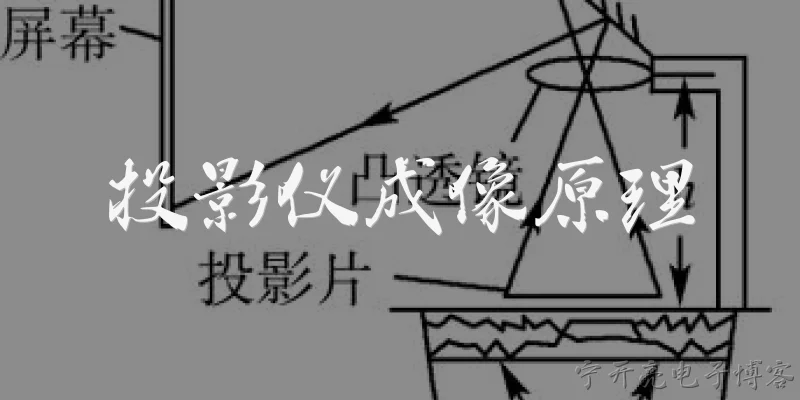
【Teacher】 Good connection! A projector uses a convex lens. The object (like a small LCD screen) is placed between the focal point and twice the focal length.
【Student】 Wait, if it's between F and 2F, the image would be real, inverted, and magnified. But the projected image on the screen is upright, isn't it?
【Teacher】 Ah, that's a common confusion. The image formed by the lens is indeed inverted. But the projector or the screen orientation can flip it. Actually, the small display inside the projector is already upside down relative to what we want on the screen.
【Student】 So the lens inverts it again, making it upright on the screen? That makes sense!
【Teacher】 Exactly. So the object is placed at a distance between f and 2f from the lens. The image is formed beyond 2f, real, inverted, and magnified. Then we flip the object or the screen to get the correct orientation.
【Student】 What if we move the object closer to the lens? Like less than f?
【Teacher】 Then the image would be virtual, upright, and magnified, like a magnifying glass. But that wouldn't project onto a screen because virtual images can't be caught on a screen.
【Student】 So for projection, we need a real image. That means the object must be beyond f.
【Teacher】 Right. And to get a larger image, we place the object just beyond f. The closer to f, the larger the magnification.
【Student】 But if it's too close to f, the image might be too far away or too large for the screen?
【Teacher】 Yes, there's a practical limit. The lens has a fixed focal length, and the screen distance is limited. So projectors often use a lens system to adjust focus.
【Student】 So how does a projector change focus? Do we move the lens?
【Teacher】 Often, yes. By moving the lens relative to the object, we change the object distance, which changes the image distance. That's how we focus the image on the screen.
【Student】 I see. So the projector is essentially a controlled application of convex lens imaging.
【Teacher】 Exactly. And modern projectors might use mirrors or multiple lenses, but the basic principle remains the same. Any questions?
【Student】 No, I think I get it now. Thanks!