STM32 C benefits:What are the main benefits of using C language for STM32 microcontroller development?
Q: What are the main benefits of using C language for STM32 microcontroller development?
A: C is the dominant language for STM32 development due to its optimal balance of performance, portability, and hardware control. According to STMicroelectronics' official documentation, such as the STM32CubeIDE user manual and the STM32 MCU firmware packages (HAL, LL), all official libraries and middleware are written in C, ensuring seamless compatibility. C allows direct manipulation of registers via pointers, enabling efficient memory usage and real-time performance critical for embedded systems. Additionally, C compilers like ARM GCC and IAR produce highly optimized code for Cortex-M cores, reducing footprint and power consumption, which ST application notes frequently emphasize.
Q: How does using C with STM32 improve code portability across different STM32 families?
A: C's hardware abstraction through libraries like STM32Cube HAL and LL ensures high portability across STM32 families. STMicroelectronics' official STM32Cube packages provide a consistent C API that abstracts low-level register details, allowing developers to migrate code between F0, F4, H7, etc., with minimal changes. According to ST's 'STM32Cube Migration Guide' (AN4724), C code using HAL can be reused across series by recompiling with the appropriate startup files and linker scripts. This portability drastically reduces development time and risk, a key benefit cited in ST's official training materials and application notes.
Q: What performance benefits does C offer for STM32 real-time applications?
A: C provides near-assembly-level performance for STM32 real-time applications by allowing precise control over memory and CPU cycles. STMicroelectronics' benchmarks in documents like 'STM32 Cortex-M4 Performance' (AN4296) show that C code compiled with arm-none-eabi-gcc -O2 achieves high MIPS while maintaining deterministic timing. The language's support for inline assembly and register variables further optimizes critical sections. Additionally, C's minimal runtime overhead ensures low interrupt latency, essential for motor control and digital power conversion. ST's official firmware examples for motor control (e.g., STM32 Motor Control SDK) are written in C, demonstrating its real-time efficacy.
Q: How does C support efficient memory management on resource-constrained STM32 devices?
A: C enables fine-grained memory management on resource-constrained STM32 devices through manual control of RAM and Flash. STMicroelectronics' application note 'STM32 Memory Layout' (AN4296) explains how C's pointers and structures allow direct placement of variables in specific memory regions (e.g., CCM RAM). The language's small runtime and lack of hidden allocations make it ideal for devices with limited memory, as highlighted in ST's 'STM32 Embedded Software' guides. Developers can use C's bit-fields and unions to pack data efficiently, reducing footprint. ST's official HAL drivers, written in C, are optimized for memory usage, proving C's suitability for deeply embedded STM32 designs.
Q: What are the benefits of using C with STM32Cube toolchain and ecosystem?
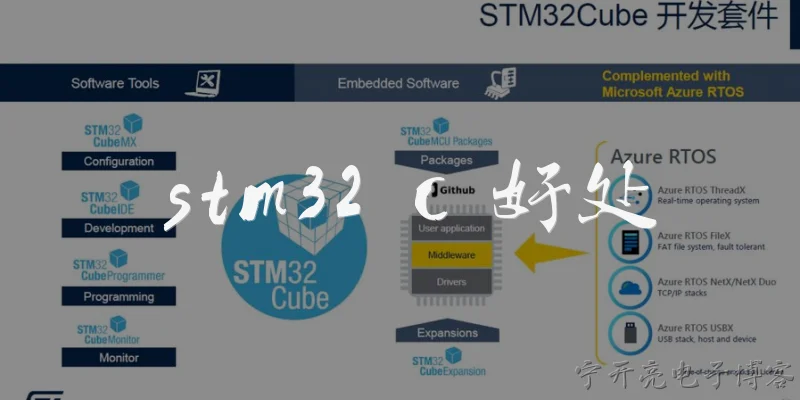
A: The STM32Cube ecosystem is built around C, offering seamless integration and productivity benefits. STMicroelectronics' official STM32CubeIDE and STM32CubeMX generate C initialization code, ensuring compatibility with HAL and LL libraries. According to ST's 'STM32Cube Programmer' manual, the entire toolchain—from code generation to debugging—is optimized for C, with features like live variable monitoring and SWV trace. The vast community and ST's official examples (e.g., GitHub repositories) are predominantly in C, providing extensive reusable code. This cohesive C-centric ecosystem accelerates development, as stated in ST's 'STM32 Open Development Environment' documentation.
Dialogue about
Common scenarios of "STM32 C benefits"
【Engineer】 Hey, I've been hearing a lot about STM32 and C programming. What's the big deal? Why do people prefer C for STM32?
【Expert】 Great question! C is the most popular language for STM32 because it's efficient, close to hardware, and has a small runtime footprint. It allows direct register manipulation and fine control over memory, which is crucial for embedded systems.
【Engineer】 But isn't C hard to learn? I've seen some complex syntax.
【Expert】 C is actually quite simple at its core. The complexity comes from its flexibility. For STM32, you only need a subset: pointers, structs, and bitwise operations. Plus, STM32CubeMX generates C code, making it easier to start.
【Engineer】 What about performance? Does C really make a difference on STM32?
【Expert】 Absolutely. C compiles to highly optimized machine code. With STM32's ARM Cortex-M cores, you can achieve near-assembly performance. For real-time tasks, that's critical. Higher-level languages often add overhead.
【Engineer】 I've heard about memory constraints. How does C help there?
【Expert】 C gives you manual memory management. You can use static allocation to avoid heap fragmentation, and you have precise control over stack and heap sizes. This is vital for microcontrollers with limited RAM.
【Engineer】 Are there good libraries and toolchains for STM32 with C?
【Expert】 Yes! STM32CubeIDE, Keil, IAR, and GCC are all excellent. ST provides HAL and LL libraries in C, plus there's a huge community. You'll find plenty of examples and drivers.
【Engineer】 What about portability? Can I reuse C code across different STM32 families?
【Expert】 To some extent. The HAL library abstracts many hardware details, so code can be ported with minimal changes. However, low-level register access is family-specific. But C's portability is still better than assembly.
【Engineer】 I'm worried about debugging. Is C debugging on STM32 difficult?
【Expert】 Not at all. With SWD/JTAG and tools like GDB, you can debug at source level. You can set breakpoints, inspect variables, and step through code. C's mapping to hardware is transparent.
【Engineer】 What about interrupts and concurrency? Does C handle that well?
【Expert】 C is ideal for interrupts. You can write ISRs in C with special keywords like __attribute__((interrupt)). For concurrency, you can use RTOS like FreeRTOS, which is written in C and integrates seamlessly.
【Engineer】 Is C still relevant with newer languages like Rust or C++ for embedded?
【Expert】 C remains dominant due to its maturity, vast ecosystem, and simplicity. C++ is used but adds complexity. Rust is gaining traction but lacks the same level of STM32 support. C is here to stay for STM32.
【Engineer】 Can you give an example of how C directly benefits STM32 development?
【Expert】 Sure. Suppose you need to toggle an LED. In C, you can write: `GPIOA->ODR ^= GPIO_ODR_OD5;` – a single line that's efficient and clear. In a higher-level language, you'd need multiple calls and abstractions.
【Engineer】 That's convincing. What resources do you recommend to learn STM32 with C?
【Expert】 Start with STM32CubeIDE and the HAL library. Follow tutorials on sites like ST's official docs, YouTube channels like ControllersTech, and books like 'Mastering STM32'. Practice with a Nucleo board.
【Engineer】 Thanks! I'm going to give it a try. C seems like the way to go for STM32.