PLC programming:What is PLC programming and why is it important in industrial automation?
Q: What is PLC programming and why is it important in industrial automation?
A: PLC programming involves creating logic instructions that control automated machinery and processes in industrial settings. It is important because PLCs (Programmable Logic Controllers) are the brains behind manufacturing lines, assembly robots, and safety systems. By writing programs in languages like ladder logic, function block diagrams, or structured text, engineers can define how inputs from sensors translate into outputs for motors, valves, and actuators. This enables precise, repeatable, and safe operations, reduces human error, and allows rapid reconfiguration for different production runs, making it essential for modern smart factories and Industry 4.0.
Q: What are the five standard IEC 61131-3 PLC programming languages?
A: The IEC 61131-3 standard defines five PLC programming languages: Ladder Diagram (LD), Function Block Diagram (FBD), Sequential Function Chart (SFC), Structured Text (ST), and Instruction List (IL). LD mimics relay logic with graphical contacts and coils, widely used for discrete control. FBD uses blocks connected by signal lines for continuous processes. SFC organizes programs into steps and transitions for sequential tasks. ST is a high-level textual language similar to Pascal, ideal for complex math and loops. IL is a low-level assembly-like language, now less common but still supported by many PLC vendors.
Q: How does ladder logic work in PLC programming?
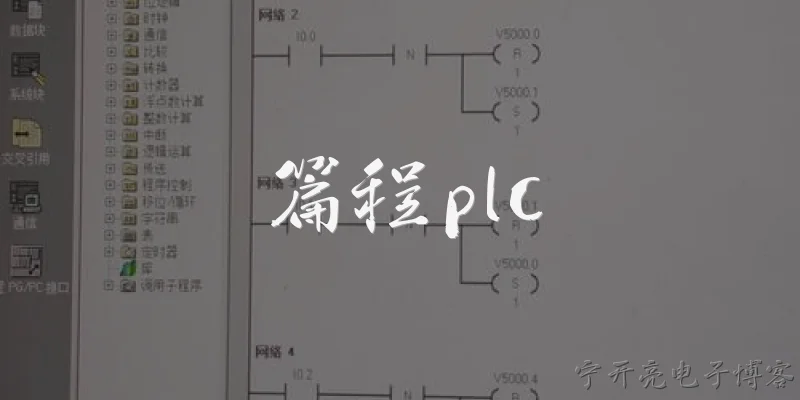
A: Ladder logic represents a PLC program as a series of rungs between two vertical power rails. Each rung contains input conditions (contacts) on the left and output actions (coils) on the right. Normally open or normally closed contacts check the state of input devices like switches or sensors. When the logical path from left to right is true, the coil energizes, turning on an output. Branches allow OR logic, while series contacts provide AND logic. Ladder logic is intuitive for electricians because it resembles relay control circuits, making it the most popular language for discrete manufacturing and safety interlocks.
Q: What is the difference between combinational and sequential PLC programming?
A: Combinational PLC programming produces outputs based solely on current input states, without memory of past events. Examples include AND/OR logic in ladder rungs. Sequential programming, by contrast, uses internal state or memory (such as latches, counters, timers, or step flags) so that outputs depend on both current inputs and the history of prior states. Sequential control is essential for processes like batch mixing, where steps must occur in order. Sequential Function Chart (SFC) and state machines are common for sequential logic, while pure combinational logic is used for simpler, immediate-response tasks like safety gates.
Q: What are best practices for writing reliable PLC programs?
A: Best practices for reliable PLC programming include using meaningful tag names and consistent comments, structuring code into modular function blocks or subroutines, and avoiding duplicate outputs. Always implement error handling and safety interlocks, and simulate or test logic offline before deployment. Use watchdog timers to detect scan cycle overruns, and document I/O assignments. Keep rungs simple and avoid overly long networks that are hard to debug. Version control your programs, back up regularly, and follow vendor-specific guidelines. Finally, ensure compliance with safety standards like IEC 61508 or ISO 13849 for critical applications.
Words of experience
Common scenarios of "PLC programming"
【Engineer】 Hi everyone, I'm Alex, a senior automation engineer. Today we're going to discuss PLC programming basics. Let's start with a simple question: what is a PLC?
【Trainee】 Hi Alex, I'm Jamie, a junior technician. PLC stands for Programmable Logic Controller. It's an industrial computer used to control machinery and processes.
【Engineer】 Exactly. PLCs are ruggedized and designed for real-time control. Can you name the basic components of a PLC?
【Trainee】 Sure: CPU, power supply, input/output modules, and a programming device. The CPU executes the logic, I/O modules interface with sensors and actuators.
【Engineer】 Good. Now, what are the five standard IEC 61131-3 programming languages?
【Trainee】 Ladder Diagram (LD), Function Block Diagram (FBD), Structured Text (ST), Instruction List (IL), and Sequential Function Chart (SFC).
【Engineer】 Correct. Which one is most commonly used in industry?
【Trainee】 Ladder Diagram, because it resembles electrical relay logic and is easy for electricians to understand.
【Engineer】 Right. Let's talk about a simple ladder logic example: a start-stop circuit with a seal-in contact. Can you describe it?
【Trainee】 Yes: a normally open start button, a normally closed stop button, and an output coil. The start button is in parallel with a normally open contact from the output coil to seal in the circuit.
【Engineer】 Perfect. Now, what about timers and counters? Give an example of each.
【Trainee】 A timer could be used to delay a motor start by 5 seconds. A counter could count parts on a conveyor and trigger an action after 100 parts.
【Engineer】 Good. How do you handle analog signals in PLC programming?
【Trainee】 Analog inputs are converted from raw values (e.g., 0-27648 for Siemens) to engineering units using scaling functions like SCALE and UNSCALE.
【Engineer】 Exactly. What about PID control?
【Trainee】 PID is used for closed-loop control, like maintaining temperature. The PLC has built-in PID function blocks that you configure with setpoint, process variable, and tuning parameters.
【Engineer】 Great. Let's discuss communication protocols. Which ones have you used?
【Trainee】 I've used Modbus RTU over RS-485, Ethernet/IP, and Profinet. Modbus is simple and widely supported.
【Engineer】 Yes. Now, what are some best practices for PLC programming?
【Trainee】 Use descriptive tag names, modular programming with functions and function blocks, add comments, and always include safety interlocks and fault handling.
【Engineer】 Excellent. That covers the basics. Any final questions?
【Trainee】 How do you debug a PLC program when it's not working as expected?
【Engineer】 Use online monitoring, force I/O, cross-reference checks, and step through the logic. Also check wiring and sensor signals. Always test in a safe environment first.
【Trainee】 Thanks, Alex. That was very helpful.
【Engineer】 You're welcome, Jamie. Keep practicing!