
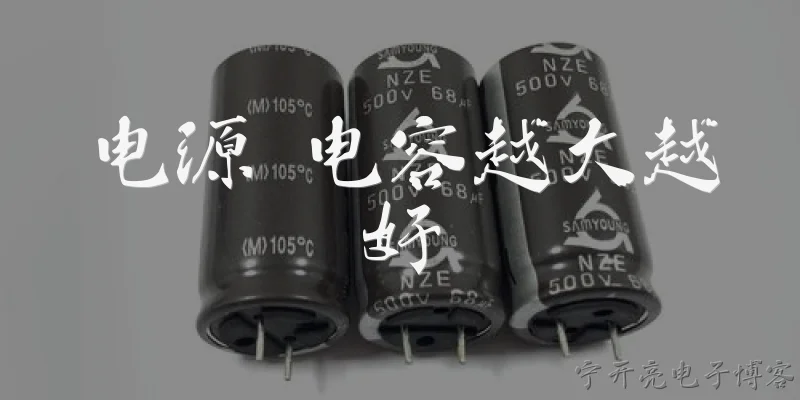
Power supply capacitors: bigger is not always better:Why is a bigger power supply capacitor not always better?
Q: Why is a bigger power supply capacitor not always better?
A: A bigger capacitor, meaning higher capacitance, is not always better because it can lead to excessive inrush current when the power supply is first turned on. This surge can stress rectifier diodes, blow fuses, or damage the switch if one is used. Also, larger capacitors often have higher equivalent series resistance (ESR) and equivalent series inductance (ESL), which can degrade high-frequency filtering performance. In switch-mode power supplies, an oversized output capacitor can slow down transient response, making the supply unable to react quickly to load changes. Physically larger capacitors may also have poorer thermal characteristics and take up more board space. Therefore, selecting the right capacitance value based on the specific application, ripple requirements, and load dynamics is far more important than simply choosing the biggest available capacitor.
Q: What are the risks of using an oversized capacitor in a linear power supply?
A: In a linear power supply, using an oversized capacitor can cause several problems. First, the inrush current at power-up can be very high, potentially exceeding the surge rating of the rectifier diodes and the transformer. This can lead to premature failure or blown fuses. Second, a larger capacitor holds more charge, so when the load is removed or the supply is turned off, the stored energy can be dangerous and may damage other components if discharged improperly. Third, the voltage regulator may have poor transient response because it takes longer to charge and discharge the large capacitor, leading to overshoot or undershoot during load changes. Finally, the physical size may not fit the board, and the higher cost is not justified if not needed. Proper design balances capacitance with the load and regulation requirements.
Q: How does capacitor size affect the performance of a switch-mode power supply?
A: In a switch-mode power supply (SMPS), capacitor size critically affects performance. A larger output capacitor reduces output voltage ripple, which seems beneficial, but it also increases the time constant of the output filter. This slows the transient response, meaning the supply cannot adjust quickly to sudden load changes, causing voltage dips or spikes. Additionally, larger capacitors often have higher ESR and ESL, which can worsen high-frequency noise and instability. The control loop of the SMPS may become unstable if the capacitor is too large, as the compensation network is designed for a specific range of output capacitance. Also, inrush current during startup can be excessive, stressing the switching components. Therefore, SMPS designers carefully calculate the optimal capacitance to balance ripple, transient response, and stability, rather than opting for the biggest capacitor.
Q: What factors should be considered when selecting a power supply capacitor?
A: When selecting a power supply capacitor, consider capacitance value, voltage rating, ESR, ESL, temperature coefficient, physical size, and cost. The required capacitance depends on load current, allowable ripple voltage, and transient response needs. A higher voltage rating provides safety margin but increases size and cost. Low ESR is crucial for reducing ripple and heating, especially in high-frequency switching supplies. ESL affects high-frequency performance. Temperature affects capacitance and lifetime; choose a capacitor rated for the operating temperature. Physical size must fit the PCB, and cost should be balanced against performance. Also, consider the type: electrolytic, ceramic, tantalum, or film, each with trade-offs. For example, ceramic capacitors have low ESR but are limited in capacitance; electrolytics offer high capacitance but higher ESR. The goal is to match the capacitor to the specific circuit requirements, not simply choose the biggest.
Words of experience
Common scenarios of "Power supply capacitors: bigger is not always better"
【Electronics Hobbyist】 Hey, I'm building a power supply for my audio amplifier and I heard that using a bigger capacitor gives cleaner power. Is that true?
【Electrical Engineer】 Not necessarily. While a larger capacitor can reduce ripple voltage, it's not always better. It depends on the application and other factors like ESR, ESL, and physical size.
【Electronics Hobbyist】 What do you mean by ESR and ESL? I thought capacitance was the main thing.
【Electrical Engineer】 ESR is equivalent series resistance, and ESL is equivalent series inductance. These parasitic elements can affect performance, especially at high frequencies. A huge capacitor might have higher ESL, which can cause ringing or instability.
【Electronics Hobbyist】 So if I use a very large capacitor, it might actually make things worse?
【Electrical Engineer】 Yes, in some cases. For example, in a linear regulator circuit, too much capacitance can cause the regulator to oscillate or have poor transient response. Also, inrush current can be a problem when charging a large capacitor.
【Electronics Hobbyist】 Inrush current? What's that?
【Electrical Engineer】 When you first power on, the capacitor acts like a short circuit, drawing a huge current to charge up. This can stress the rectifier diodes, blow fuses, or trip circuit breakers. A smaller capacitor limits that surge.
【Electronics Hobbyist】 But I've seen designs with massive capacitor banks. Why do they do that?
【Electrical Engineer】 Those are often for high-power applications where ripple current is high, and they may use multiple capacitors in parallel to lower ESR and handle ripple. But it's not just about total capacitance; it's about the right combination.
【Electronics Hobbyist】 So how do I choose the right capacitor for my power supply?
【Electrical Engineer】 First, determine your load current and acceptable ripple voltage. Then calculate the required capacitance using the formula C = I_load / (2 * f * V_ripple) for a full-wave rectifier. But also consider ESR and ripple current rating.
【Electronics Hobbyist】 That formula seems simple. But what about ESR?
【Electrical Engineer】 ESR causes heating and voltage drops. A capacitor with low ESR is better for high-frequency ripple. Sometimes, placing a small ceramic capacitor in parallel with a large electrolytic can improve high-frequency response.
【Electronics Hobbyist】 So bigger isn't always better because of these parasitic effects and inrush current?
【Electrical Engineer】 Exactly. Also, physical size and cost. A larger capacitor takes up more space and costs more. Sometimes a well-designed smaller capacitor with low ESR is more effective.
【Electronics Hobbyist】 What about for audio amplifiers? I've heard that big capacitors improve bass response.
【Electrical Engineer】 That's a common myth. The power supply capacitors mainly affect ripple and transient response. If the amplifier has good PSRR (power supply rejection ratio), the capacitor size matters less. However, for high-power transients, a reservoir capacitor can help, but it's not a cure-all.
【Electronics Hobbyist】 So I should focus on the right capacitance value and low ESR rather than just maxing out the microfarads?
【Electrical Engineer】 Yes, and also consider the voltage rating, temperature, and lifetime. A well-engineered power supply balances all these factors. Don't just assume bigger is better.