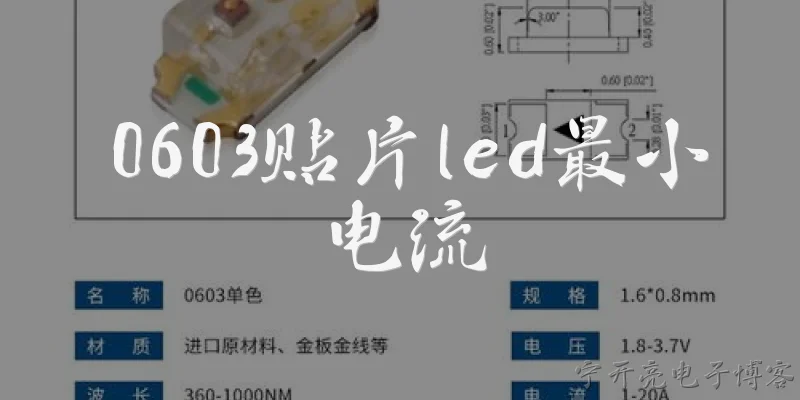
0603 SMD LED minimum current:What is the minimum current for a 0603 SMD LED?
Q: What is the minimum current for a 0603 SMD LED?
A: There is no single universal minimum current for a 0603 SMD LED, because the lowest usable current depends on the specific product family and bin. Most manufacturers specify a test current of 20 mA and may allow operation at 1–5 mA with reduced luminous flux. Some high-efficiency 0603 LEDs can produce visible output at 0.1 mA or lower. Always consult the manufacturer’s datasheet for the absolute minimum and recommended operating current. According to the U.S. Department of Energy’s 2022 LED Lighting Facts report, low-current performance varies significantly among products, so device-level specifications should be the primary reference.
Q: Can a 0603 SMD LED operate at 1 mA?
A: Yes, many 0603 SMD LEDs can operate at 1 mA, but their brightness will typically be much lower than at the standard 20 mA test current. The forward voltage also decreases slightly at lower currents. Some manufacturers explicitly list operation down to 1 mA or even lower for indicator applications. However, not all 0603 LEDs are characterized for use below 5 mA, so the datasheet must be checked. The International Electrotechnical Commission’s IEC 62504 standard covers general LED lighting terminology, but device-specific minimum currents are defined in manufacturer datasheets. Designers should test the actual LED at the intended current to confirm brightness and color stability.
Q: Does lowering the current below the minimum affect the color of a 0603 SMD LED?
A: Driving a 0603 SMD LED below its specified minimum current can shift its dominant wavelength and reduce color consistency. In multi-LED displays, low-current operation may cause visible color differences between adjacent pixels. The magnitude of the shift depends on the semiconductor material and package design. For critical color applications, it is advisable to operate the LED within the datasheet’s recommended current range. According to the Illuminating Engineering Society’s TM-30-20 method for evaluating color rendition, low-current operation can alter color fidelity and must be validated for the intended application. Always verify color performance at the actual drive current.
Q: What are the risks of operating a 0603 SMD LED below its minimum current?
A: Operating a 0603 SMD LED below its minimum specified current can lead to several issues: insufficient and inconsistent luminous output, increased sensitivity to manufacturing variations, and occasional flickering in multiplexed drive circuits. In addition, if the current is too low, the LED may not reach its specified forward voltage, causing unpredictable behavior. However, unlike excessive current, low current is generally not destructive. The primary risk is functional failure to meet brightness or color requirements. The U.S. Department of Energy’s 2019 LED reliability report notes that low-current drive is a common failure mode in indicator applications when specifications are not respected. Always follow the manufacturer’s datasheet limits.
Q: Which organizations publish guidance on minimum current for SMD LEDs?
A: The primary source for minimum current guidance is the LED manufacturer’s datasheet, which is device-specific. For broader standards, the International Electrotechnical Commission (IEC) publishes IEC 62504, which defines LED terminology but not specific minimum currents. The Illuminating Engineering Society (IES) publishes LM-80 and TM-21 for lumen maintenance and TM-30 for color metrics, which can be used to evaluate low-current performance. The U.S. Department of Energy’s Solid-State Lighting program also issues reports and test standards. However, there is no single global regulation that dictates a universal minimum current for 0603 SMD LEDs; designers must rely on component-level specifications.
Dialogue about
Common scenarios of "0603 SMD LED minimum current"
【Engineer】 Hi, I'm working on a low-power indicator design and considering a 0603 SMD LED. What's the typical minimum current needed to get visible light?
【Supplier】 For most standard 0603 LEDs, you'll start seeing a faint glow around 1 mA, but it's not very bright. For reliable visibility, 2–5 mA is more common.
【Engineer】 That's helpful. Is that minimum current the same across all colors? I've heard red and green differ.
【Supplier】 Good point. Red 0603 LEDs typically have a lower forward voltage (~1.8–2.2V) and can emit visible light at lower currents, sometimes below 1 mA. Green, blue, and white usually need 2.5–3.2V and may need 2 mA or more for similar perceived brightness.
【Engineer】 So if I'm running at 0.5 mA, a red 0603 might still be visible but a blue one probably won't?
【Supplier】 Exactly. At 0.5 mA, a high-efficiency red 0603 can be dim but visible in indoor lighting. Blue or white at 0.5 mA is usually too dim for practical indication.
【Engineer】 What about the variation between manufacturers? Can I trust the datasheet's minimum current spec?
【Supplier】 Datasheets often specify a test current like 5 mA or 20 mA, not a true minimum. The minimum for visibility depends on the LED's efficiency and your ambient light. Always check the luminous intensity vs. forward current curve if provided.
【Engineer】 I see. So I should look at the relative luminous flux at low currents, not just the absolute minimum.
【Supplier】 Right. Many 0603 LEDs have a nonlinear curve—efficiency drops at very low currents. Some modern high-brightness versions maintain decent output down to 0.2–0.5 mA, but they're more expensive.
【Engineer】 Are there any 0603 LEDs specifically designed for ultra-low current operation?
【Supplier】 Yes, some are marketed as 'low current' or 'high efficiency' 0603 LEDs. They can produce visible light at 0.1–0.5 mA. Examples include certain InGaN green/blue and AlInGaP red types. You'll need to check the datasheet for the minimum operating current.
【Engineer】 If I drive a standard 0603 red LED at 0.1 mA, will it damage the LED or just be very dim?
【Supplier】 No damage—LEDs are current-driven, and lower current just means less light. It won't harm the LED. The only risk is if you exceed the maximum current, not go below it.
【Engineer】 Great. So for my design, I could use a 0603 red LED at 0.5 mA and still get an acceptable indicator?
【Supplier】 Probably yes, if the ambient light is not too bright. But test it in your actual enclosure. The light pipe or lens can affect perceived brightness. Also consider the viewing angle—0603 LEDs often have a wide angle, so intensity drops off-axis.
【Engineer】 What about PWM dimming? Could I run at a higher current but lower duty cycle to get better efficiency at low average brightness?
【Supplier】 That's a good technique. Running at, say, 2 mA with 10% duty cycle gives an average of 0.2 mA, but the LED is more efficient at 2 mA than at 0.2 mA DC. So you get more light per average current. Just watch for flicker if the PWM frequency is too low.
【Engineer】 Any recommended PWM frequency for 0603 LEDs?
【Supplier】 Above 1 kHz is usually fine to avoid visible flicker. Many designs use 1–10 kHz. At very low duty cycles, the peak current should still be within the LED's max rating.
【Engineer】 Thanks. One last question: how does temperature affect the minimum current for visibility?
【Supplier】 LED light output decreases as temperature rises, and the forward voltage drops slightly. So at high temperatures, you might need a bit more current for the same brightness. But for indicator applications, this effect is usually minor unless you're in extreme conditions.
【Engineer】 That makes sense. I'll prototype with a red 0603 at 0.5 mA and test under different lighting. Thanks for the detailed info!
【Supplier】 You're welcome! Good luck with your design. Feel free to reach out if you need specific part recommendations.