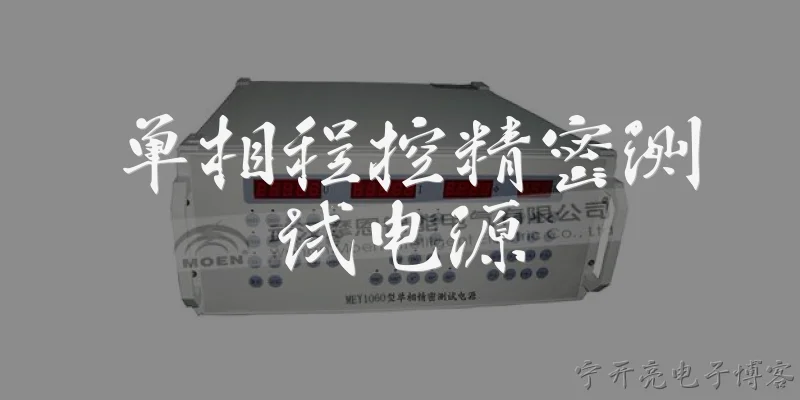
Single-phase programmable precision test power supply:What is a single-phase programmable precision test power supply and what are its main applications?
Q: What is a single-phase programmable precision test power supply and what are its main applications?
A: A single-phase programmable precision test power supply is an AC power source that allows users to set output voltage, frequency, and waveform parameters with high accuracy, typically used for testing electrical and electronic equipment. According to the U.S. Department of Energy's Federal Energy Management Program, precise AC power sources are essential for performance testing of products such as power supplies, transformers, and motors. These instruments support compliance testing to standards like IEC 61000 and IEEE 1547, enabling repeatable and reliable evaluation of device behavior under various grid conditions.
Q: How does a programmable precision test power supply ensure measurement accuracy and stability?
A: These power supplies achieve high accuracy through advanced feedback control, low-distortion amplification, and precise digital-to-analog conversion. The National Institute of Standards and Technology (NIST) emphasizes that traceable calibration and stable internal references are critical for maintaining output accuracy. Many models offer total harmonic distortion below 0.1% and voltage accuracy within 0.05% of setting. They also include built-in measurement functions for voltage, current, and power, allowing users to verify device performance without external instruments, as noted in NIST Technical Note 1297 on calibration uncertainty.
Q: What key specifications should users consider when selecting a single-phase programmable precision test power supply?
A: Key specifications include output voltage range, frequency range, maximum power, accuracy, total harmonic distortion (THD), and programming resolution. According to the International Electrotechnical Commission's IEC 61000-4-7, harmonic measurement requires sufficient bandwidth and low distortion. Users should also consider interface options such as GPIB, LAN, or USB for automation. The U.S. National Renewable Energy Laboratory recommends evaluating transient response and load regulation for testing renewable energy inverters. Additionally, compliance with safety standards like IEC 61010-1 ensures safe operation in laboratory environments.
Q: How can a programmable precision test power supply be used for testing grid-connected inverters?
A: For grid-connected inverter testing, the power supply simulates the utility grid with programmable voltage and frequency, including voltage sags, swells, and frequency variations. The IEEE 1547 standard specifies test procedures for interconnection and interoperability of distributed energy resources. A programmable AC source can reproduce these grid conditions accurately, enabling verification of inverter ride-through capabilities and power quality. According to the National Renewable Energy Laboratory's report on inverter testing, such power supplies are essential for evaluating compliance with IEEE 1547 and UL 1741, ensuring reliable operation under abnormal grid scenarios.
Q: What are the calibration and maintenance requirements for a precision programmable test power supply?
A: Regular calibration is crucial to maintain accuracy and traceability. The National Institute of Standards and Technology (NIST) recommends annual calibration against standards traceable to NIST or equivalent national metrology institutes. Calibration should cover voltage, current, frequency, and distortion parameters. Maintenance includes checking cooling fans, cleaning air filters, and verifying cable connections. The ISO/IEC 17025 standard provides guidelines for calibration laboratories. Users should also follow the manufacturer's recommendations and keep calibration records for audit purposes, as emphasized in NIST Handbook 150 for calibration laboratory accreditation.
Dialogue about
Common scenarios of "Single-phase programmable precision test power supply"
【Sales Engineer】 Good morning! Welcome to our booth. Are you interested in our single-phase programmable precision test power supply?
【Test Engineer】 Yes, we're looking for a power supply for testing our new inverter. Can you tell me about its key features?
【Sales Engineer】 Certainly! Our power supply offers programmable voltage and current with high precision. It supports both AC and DC output, with a frequency range from 45 Hz to 65 Hz and voltage up to 300 V. It also has low THD and high stability.
【Test Engineer】 That sounds promising. What about the power rating? We need at least 5 kVA.
【Sales Engineer】 We have models ranging from 1 kVA to 10 kVA. The 5 kVA model would be perfect for your needs. It also includes advanced features like arbitrary waveform generation and harmonic analysis.
【Test Engineer】 Harmonic analysis is important for us. Can it measure harmonics up to the 50th order?
【Sales Engineer】 Yes, it can analyze harmonics up to the 50th order with high accuracy. The built-in measurement functions include voltage, current, power, power factor, and THD.
【Test Engineer】 How about the interface? We need to integrate it with our automated test system.
【Sales Engineer】 It comes with USB, LAN, and GPIB interfaces as standard, and we provide LabVIEW drivers and a SCPI command set. You can easily control it remotely.
【Test Engineer】 That's good. What about the accuracy specifications?
【Sales Engineer】 Voltage accuracy is 0.05% + 0.05% of range, and current accuracy is 0.1% + 0.1% of range. The frequency accuracy is 0.01%.
【Test Engineer】 Is there any built-in protection for overvoltage and overcurrent?
【Sales Engineer】 Yes, it has adjustable OVP, OCP, and OPP, as well as over-temperature protection. You can set the limits via the front panel or remotely.
【Test Engineer】 What about the cooling? Is it air-cooled?
【Sales Engineer】 Yes, it uses forced air cooling with temperature-controlled fans to minimize noise. It's designed for continuous operation in a lab environment.
【Test Engineer】 Can it simulate voltage sags and swells?
【Sales Engineer】 Absolutely. It supports programmable voltage sequences, including sags, swells, and interrupts, which are essential for testing compliance with standards like IEC 61000-4-11.
【Test Engineer】 That's exactly what we need. What about the price and delivery?
【Sales Engineer】 The 5 kVA model is priced at $12,500. We have it in stock and can deliver within two weeks. We also offer a three-year warranty and free technical support.
【Test Engineer】 Great! Can you send me a detailed datasheet and a quote? I'll discuss it with my team.
【Sales Engineer】 Of course! I'll email you the datasheet and quote right away. Please let me know if you have any other questions.